https://web.archive.org/web/20030623114437/http://www.de.psu.edu:80/cpp/sphs.htm
Like a huge walk-in refrigerator, the springhouse handles all the food storage needs of the plantation. The springhouse lies roughly thirty feet from the western end of the farmhouse and is currently the most western building on the plantation.
Spring houses, though interesting to us in these times of electric refrigeration, were so common to our colonial ancestors that little mention is made of them in colonial documents. Most of the evidence collected about springhouses comes from the buildings that still exist today. The common colonial springhouse was a bank springhouse. First, a bank or hillside was partially excavated, then the walls of the springhouse were built around the stream. These walls were generally one-and-one-half feet thick and made of fieldstone instead of the more expensive brick. After these walls were built, they tended to be whitewashed to give the springhouse a finished appearance. The springhouse was typically located under trees to shade the house from sunlight in the summer.
The interior of a common colonial springhouse contained a stone pallet for a floor around which water flowed on three sides. Windows, if any, were small and recessed and used to circulate air in the building. Shelves were a universal feature in colonial springhouses. They were usually three or four feet above the water and used to keep things cool which could not be put into water.
The combination of the house being slightly underground, constantly flowing water, thick walls, and small, recessed windows helped keep the illustrative colonial springhouse’s temperature around fifty-five degrees Fahrenheit.
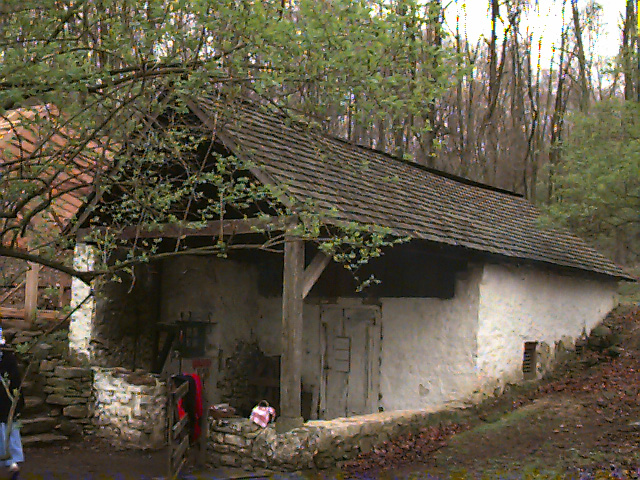
The Pratt springhouse is very close to the common colonial springhouse described above. It is of a banked design and is two stories tall. The exterior walls are made of fieldstone which is plastered and whitewashed. The interior of the first floor of the springhouse contains a stone base with a concrete cap measuring eighteen by five feet. This cap is surrounded on all four sides by water flowing into the springhouse. A small island of stone connects this cap to the springhouse door. Shelves project twelve inches at three feet above the water on the east and west walls.
Water flows into the springhouse from the northwest corner. In this corner, the water is eighteen inches deep. In the rest of the room, the water is twelve inches deep. The flow of water in the springhouse exits in the southeast corner through a pipe that leads to a stream that runs between the farmhouse and springhouse.
The size of the Pratt springhouse is one thing that distinguishes it from the common colonial springhouse. Measuring sixteen by twenty-four feet, it is larger than most springhouses of the era. This is because it was enlarged in the early 19th century to accommodate dairying on a larger scale.
The western wall of the springhouse extends out another fourteen feet from the front of the building. This, combined with the roof extending out the same distance, provides an outdoor work area. Since the western wall blocks most of the wind and the roof keeps out the rain, any activities that needed to be done outdoors could be done in adverse conditions. These activities most likely included candle making, as evidenced by the fireplace located inside the work area.
The Pratt springhouse is an excellent example of our colonial ancestors living off the land. More than one hundred years before the advent of electric refrigeration, the Pratt family was able to keep food cool and fresh using only the flowing water on their property.