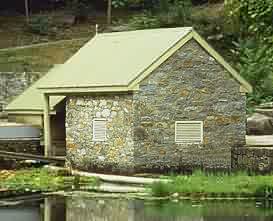
spring house at Morgan’s Spring, West Virginia
A colonial Pennsylvania spring house
Spring houses were small, enclosed one room buildings used before the days of refrigeration to keep food cool. Under the best of circumstances it was built over a spring where the water was coldest as it bubbled up to the surface. Otherwise a small stream was diverted from a nearby creek which ran through the building. The cool water running though the spring house kept the interior of the enclosed building cool. My mother often used this same principle when I was a kid by setting a bottle of milk in the small ditch next to the house. This water coming out of the mountains was as cold as any refrigerator. As pretty as the spring house to the right is, a spring house doesn’t need to be extravagant – a little four walled building built out of wood will do.
Kristi Gross supplies us with this charming word picture…
As a youngster I often visited a farm with a spring house. A spring house is a wonderful little building. The one I visited was only about 4 feet high at the roof level. Adults had to bend over to enter. It was a simple little building with a wooden door latched by a hook and eye. This spring house had a hole near the ground on each side, and a stream of water flowing right through the building. A big trough was built in the center of the water with the water always half filling the trough with clear cold water.
This trough was made of wood which sat long ways in the stream. It looked much like a long military rifle box, about a yard long and 6 inches deep with a 2-3 inch crack on the bottom of the short sides for the water to flow through. (If it was made of cement it might prove more long lasting and provide a better cooling effect than one made of wood.) Bottles containing food were placed in the flowing water within this trough. The upper sides of the box kept the bottles from flowing away.
Crocks or jars of milk, butter, eggs, anything my friend, Alma, wanted to keep cold was kept in the spring house and it was my childhood joy to be sent to the spring house after something for her kitchen use. This was especially so in the hot Oklahoma summers as it was always 20-40 degrees cooler here than anyplace outside.
Alma kept her butter in a small wide mouthed mason jar, eggs were in a wire basket and the milk was kept in a large crock and often a large pickle jar. Sometimes she had lemonade or iced tea in the spring house as well when slaughtering was going on. The inner walls of the spring house had shelves where she might set pies and baskets of potatoes, onions, or other garden produce. These were well above the water level of course. Some jars of fruit, vegetables, etc., were stored here as well.
This was used as a ‘step-up’ from the cellar. Things kept here were also stored in the cellar, but as it took more effort to fetch things from the cellar, things were moved as might be needful up to the spring house for more immediate accessibility.
Her spring house was ideally situated in the farmyard under a big shade tree that also helped to keep it cool. Also kept in the spring house was a metal dipper for drinking purposes, although under present conditions, I don’t think this is too practical unless you are absolutely certain your water source is clean. But when I was a child getting sick from drinking the water was the furthest thing from our minds and no one suffered from ill effects from drinking it.
Kristi continues…
My thinking in terms of self-sufficiency and y2k issues would be that a souped-up extra fancy spring house could be built today for less than $50 dollars with used lumber scraps and tin, heavily insulated with big pieces of foam insulation that can be found just about anywhere. This could make a super little cool spot for keeping things cool without electricity.
You could also use this same idea, minus the building by inserting a wooden box with holes drilled in the sides and placed in the stream. Or an even less expensive option might be to set a heavy stryrofoam chest with holes drilled for water flow into a stream. Any of these, situated and anchored in a pond, creek or marshy place, could keep items cool enough to keep them from rapidly spoiling.